Skip to content
English
  • 検索欄が空のため、提案はありません。

座標系の使い方 -PIX4Dmatic

Image coordinate system

PIX4Dmatic allows the image coordinate system to be manually set or edited.

To edit the image horizontal or vertical coordinate systems, click on the edit icon edit.svg in the lower right corner of the screen where the Cameras tab is.

Camera_Image_CRS_PIX4Dmatic.png

After clicking on the edit icon, the Set image coordinate reference system (CRS) dialog box will open.

Image_CRS_picker.jpg

Unless a camera is in the PIX4Dmatic camera database or the images have the correct XMP tags, the default image coordinate system is WGS84 (EPSG: 4326) for the horizontal and EGM96 (EPSG: 5773) for the vertical.

Warning: For PPK or RTK-enabled drones, it is advised to understand what coordinate reference system the images were acquired in. NTRIP networks or base stations may broadcast corrections on something other than PIX4Dmatic's default CRS, and this coordinate system should be set accordingly. Otherwise, an incorrect transformation will occur, and a shift in the outputs may result.

GCP座標系

Both the horizontal coordinate system and the vertical coordinate system can be defined in the Tie Points table:

Pix4Dmatic_set_coordinate_system.jpg

The GCP coordinate reference system (CRS) window will pop up.

Known_CRS_PIX4Dmatic.png

To select the horizontal coordinate reference system:

  • ~において 水平座標系 ダイアログ、 検索またはコピー&ペースト:
    • The name or
    • 座標系のEPSGコード。

垂直座標系を選択するには:

  • ~において 垂直座標系 ダイアログ、 検索またはコピー&ペースト:
    • The name or
    • 座標系のEPSGコード。
  • (オプション)ジオイド:選択した垂直座標系がジオイドに対応しており、かつPIX4Dmatic にジオイドモデルが存在する場合は、ドロップダウンリストからジオイドモデルを選択してください。
  • (任意)ジオイド高:選択した垂直座標系がジオイドに対応しているものの、PIX4Dmatic にジオイドモデルがない場合は、その地点のジオイド高の値を入力してください。

詳細および対応しているジオイドの一覧については、「 PIX4Dmaticでのジオイドの使用方法」をご覧ください。

Note: The Geoid height value is used to convert the image geolocation (WGS 84 ellipsoid or EGM96 geoid) into the desired project coordinate system.

プロジェクト座標系

The horizontal and vertical coordinate reference systems of the project are defined based on the imported image geolocation data or the selected GCPs coordinate reference system:

The project coordinate system is always visible on the bottom bar:
Pix4Dmatic_project_coordinate_system_bar.jpg
  • When the GCPs coordinate system is not defined, PIX4Dmatic will default the project coordinate system to the corresponding UTM zone based on the position of the image geolocation. The vertical coordinate system is set to ellipsoidal heights*.
例: When importing images with image geolocation in Switzerland the automatically assigned project coordinate system is:
  • Horizontal: WGS 84 / UTM zone 32N - EPSG 32632.
  • Vertical: WGS 84 - EPSG 7030 ellipsoid.
Note: For non-RTK captures, PIX4Dcatch automatically sets the horizontal coordinate reference system to WGS84 (EPSG:4326) and the vertical coordinate reference system to EGM96 height (EPSG:5773).
*Note: No GCPs are required to change the coordinate reference system in a PIX4Dmatic project.
Project_CRS_Matic.png
  • When GCPs coordinate system is defined, the project coordinate system corresponds to the GCPs coordinate systems. If the GCPs coordinate system is geographic the corresponding UTM zone is used for the project coordinate system.
例: When importing images with image geolocation in Switzerland and defining the GCPs coordinate system as CH1903+ / LV 95 - EPSG 2056 with ellipsoidal heights, the project coordinate system is:
  • Horizontal: CH1903+ / LV 95 - EPSG 2056.
  • Vertical: Bessel 1841 - EPSG 7004 ellipsoid.

Arbitrary coordinate system


Arbitrary or local coordinate systems are typically used in construction sites, or mining. The origin of the system is based on arbitrary (local) points and is not aligned with any known coordinate system.

In PIX4Dmatic, Ground Control Points (GCPs) with arbitrary coordinates can be used to georeference the project in an arbitrary coordinate system.

2024-05-30_11-22-44

The recommended workflow [Method - A] is to:

  • Create a project and import images.
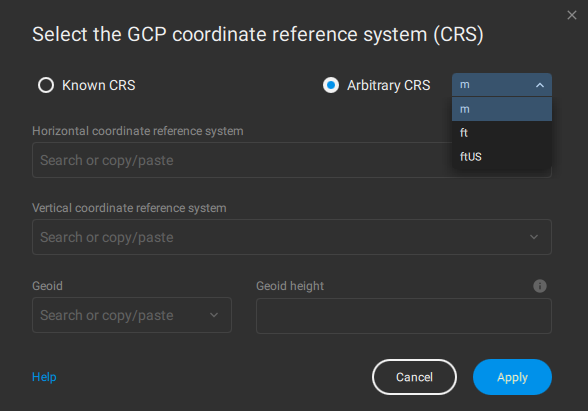
  • In the Select the GCP coordinate reference system (CRS), click Arbitrary CRS and select the units.
  • Import the GCPs.
  • Mark GCPs on images.
  • Run Calibration step.
Note: The benefit of the recommended workflow [ Method - A] is that there is no need to rerun the Calibration step. The downside is that, since the position of images and GCPs are not aligned, it is not possible to get a rough position of the GCPs on image and it can consequentially take longer to locate and mark each GCP.

The alternative workflow [Method - B] is to:

  • Create a project and import images.
  • In the Select the GCP coordinate reference system (CRS), click Arbitrary CRS and select the units.
  • Run Calibration step.
  • Mark at least 3 MTPs in the exact area where the GCPs appear.
  • In the Tie Points table, change the type of marked MTP to GCPs and manually insert their coordinates.
  • Rename the MTPs to the actual name of the GCP in the import file.
  • Run the Reoptimization step.
  • Import and mark additional GCPs.
  • Run the Reoptimization step.
Note: The benefit of the alternative workflow [ Method - B] is that the project is first georeferenced based on a small amount of GCPs. This way images and GCPs are roughly aligned, and it is easier to detect and mark additional GCPs.
By first calibrating the project, the Run AutoGCP algorithm is enabled which can additionally speed up the marking of GCPs.

Import coordinate system

PIX4Dmatic support custom site localization files formatted in Well-Known Text (WKT), a standardized, text-based representation that includes translation, rotation, and scaling parameters.

The files support in PIX4Dmatic to import a coordinate system are the following: txt, prj, wkt, csv, and Trimble formats .dc and .cal.

For further information, read the following article: How to obtain a Site Localization file for PIX4Dmatic and PIX4Dcloud

Horizontal grid corrections and transformations

PIX4Dmatic supports the most common horizontal grid corrections and transformations.

The corrections will be used automatically based on the selected coordinate systems.

Information: Please contact support if you have additional questions regarding horizontal grid corrections and transformations or if you believe that the transformation you need is not included or precise enough.