
Introduction
A False Color Composite in agriculture is a visual representation using satellite or drone imagery where the colors displayed do not correspond to the colors we see with our naked eyes (true color). Instead, different bands of the spectrum are assigned to the red, green, and blue color channels of an image display.
This technique is valuable in agriculture because it highlights features and conditions of crops that are otherwise hard or impossible to detect in a standard color orthomosaic.
Access the tool
To access the tool:
- Click on a Multispectral or RGB orthomosaic.
- Click on Visual.
- Select the Color band display scheme.
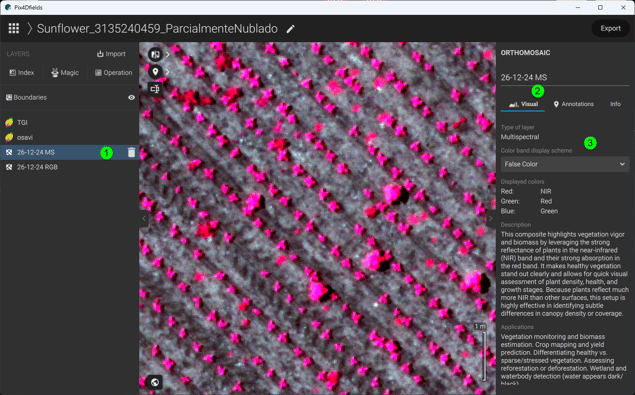
List of color band display schemes
| Name | Source Type | Bands (Assigned to RGB) | Description | Application Highlight | Visual Trail Highlight |
| Default | RGB | (Original RGB) | Produces a natural-looking image that closely resembles how the human eye would see the Earth. | ||
| Traditional MSP | MSP | NIR, Blue, Green | Classic visualization using NIR, Blue, and Green bands to create a powerful visualization of vegetation health and biomass. | General vegetation analysis, crop health monitoring, and estimating biomass. | Healthy vegetation appears in bright red or crimson tones. |
| Red Edge Composite | MSP | Red Edge, NIR, Green | Designed to highlight vegetation dynamics, especially chlorophyll content and subtle canopy stress. | Monitoring plant stress and nutrient variability. Tracking crop growth stages. | Healthy vegetation - intensely bright lime green. |
| Agricultural Stress Composite | MSP | NIR, Red Edge, Red | Emphasizes subtle changes in plant physiology—particularly in the early stages of crop stress. | Powerful for pre-symptomatic stress detection by revealing variations in chlorophyll. | Healthy vegetation - intensely bright yellow. |
| False Color | MSP | NIR, Red, Green | Also called CIR maps.(Color Infrared) Highlights vegetation vigor and biomass by leveraging the strong reflectance of plants in the near-infrared (NIR) band. |
Vegetation monitoring, biomass estimation, and quick visual assessment of plant density. | Healthy vegetation - vibrant magenta/pink. |
| Red Edge Emphasis | MSP | Red Edge, Red, Green | Emphasizes subtle variations in plant health, especially before symptoms are visible in the Red/NIR spectrum. | Early detection of plant stress and monitoring nitrogen levels or chlorophyll breakdown. | Healthy vegetation appears bright or distinct in red tones. |
| Minimal Vegetation Contrast | MSP | Red, Green, Red Edge | Creates a high-contrast visualization, making it effective for delineating vegetation and other land cover types. | Excellent for high-contrast delineation of vegetation and bare ground. | Vegetation - intensely bright white to light blue, almost glowing. |
| NIR_RE_Green | MSP | NIR, Red Edge, Green | Combines strong vegetation reflectance (NIR), early stress sensitivity (RE), and visible spectrum (Green). | Effective in discriminating crop types from each other or from weeds. | Healthy vegetation is vivid yellow/gold. |
| NIR_Green_Red | MSP | NIR, Green, Red | A reverse-style composite, swapping traditional roles to invert the look of vegetation. Provides contrast boosts. | Highlight canopy structure or variability in high-biomass crops. | Vegetation (trees/dense areas) is vibrant orange/red tones. |
| RE_NIR_Red | MSP | Red Edge, NIR, Red | Great for highlighting biomass variability and subtle stress. | Monitoring biomass accumulation and crop maturity analysis. | Healthy vegetation is bright yellow-orange tones. |
| SWIR | Satellite | B12, B08, B04 (SWIR-2202, NIR, Red) | Combines SWIR with visible bands to provide detailed information on moisture content and surface composition. | Burn scar and fire severity detection, soil moisture and drought monitoring. | Burned/dry areas are Bright yellow or white. |
| Agriculture | Satellite | B11, B08, B02 (SWIR-1613, NIR, Blue) | Leverages the moisture sensitivity of SWIR-1, the chlorophyll reflectance of NIR, and the surface visibility of the blue band. | Powerful tool for monitoring crop health and estimating plant and soil moisture levels. | Healthy, dense vegetation is Greenish tones. |
| Geology | Satellite | B12, B11, B02 (SWIR-2202, SWIR-1613, Blue) | Highly effective for analyzing thermal features, moisture, burned areas, and geological formations. | Burned area detection, moisture analysis, and geological mapping. | Burn scars and dry soils appear bright yellow, orange, or pinkish. |
| RGB_8_6_4 | Satellite | B08, B06, B04 (NIR, Red edge-740, Red) | Emphasizes subtle differences in vegetation health and vigor, especially before visible symptoms emerge. | Early detection of nutrient deficiencies or disease onset. Precision agriculture. | Healthy vegetation appears bright red or pink. |
| RGB_8_5_4 | Satellite | B08, B05, B04 (NIR, Red edge-782, Red) | Highlights subtle variations in plant health and canopy structure. Ideal for detecting stress early. | Early crop stress detection and monitoring chlorophyll sensitivity. | Healthy vegetation is bright red to pink tones. |
| RGB_8_11_4 | Satellite | B08, B11, B04 (NIR, SWIR-1613, Red) | Highlights vegetation health (from NIR) while also including moisture sensitivity from SWIR. | Crop condition and moisture status, early drought stress detection. | Healthy vegetation is bright red. |
| RGB_8_11_12 | Satellite | B08, B11, B12 (NIR, SWIR-1613, SWIR-2202) | A powerful composite for assessing vegetation moisture, burn scars, and soil dryness. | Burn severity mapping and soil moisture and drought analysis. | Burned/dry areas are bright blue or cyan. |
| RGB_11_8_3 | Satellite | B11, B08, B03 (SWIR-1613, NIR, Green) | Blends moisture, biomass, and photosynthetic activity in a single view. | Monitoring crop water stress and plant health variations. | Healthy vegetation is green to yellow-green. |
| Yellow Composite | RGB | Red, Green, (Red + Green) / 2 | Qualitative visualization to dampen blue and highlight relative yellowness. | Quick screening for chlorosis/senescence (yellowing) gradients. | Chlorotic/dry vegetation/residue is bright yellow/gold. |
| RBG Composite | RGB | Red, Blue, Green | Creates enhanced contrast between vegetation and soil, making crop rows more distinct. | Enhanced crop row visibility and agricultural field monitoring. | Vegetation is vibrant purple/magenta tones. |
| GRB Inverted Composite | RGB | Green, Red, Blue | An inversion of traditional RGB that creates strong contrast between vegetation and soil. | Clear delineation of crop rows and enhanced visualization of canopy structure. | Vegetation is vibrant orange/red tones. |
| Excess Green Composite | RGB | (2*G - B - R), Green, Red | Uses the Excess Green Index (ExG) to highlight green vegetation. | Weed detection in crops and vegetation segmentation. | Vegetation is vibrant reddish-orange tones. |
| Color Infrared Simulated | RGB | Red, Green, - (2 *Green - Red) | Simulates traditional color infrared film, useful for a general vegetation vigor overview. | Vegetation vigor & biomass monitoring. | Vegetation - bright white to light blue. |
| Band only | MSP Satellite RGB |
Band, Band, Band | The same band is added to all channels. |